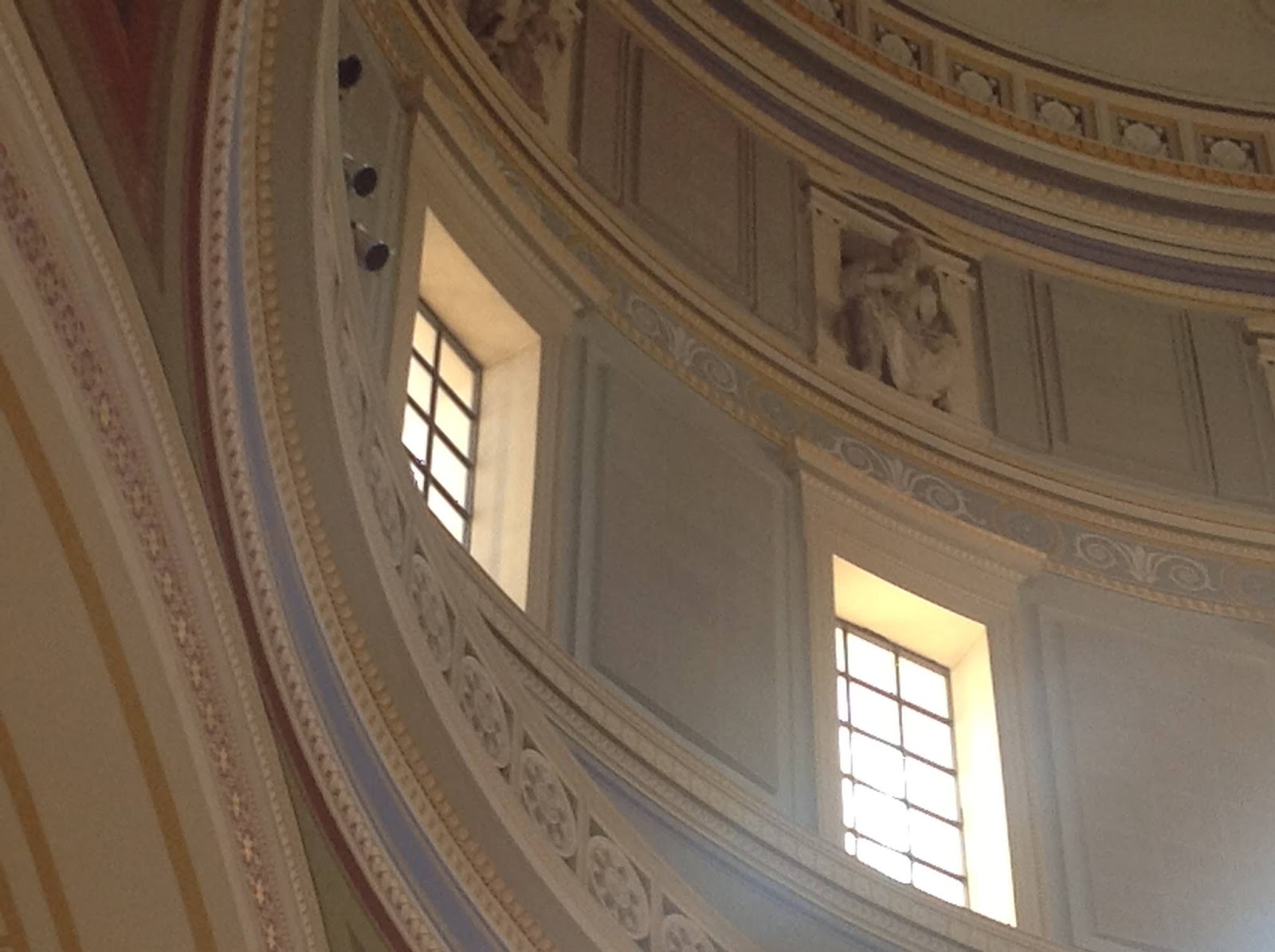
Betrachtet man das Schloss von der Langen Brücke aus, fällt vor allem die riesige kupfergrüne Kuppel über dem Rotbraun auf, aber die gehört gar nicht zum Schloss, sondern ist das Dach der Nikolaikirche. Ein klassizistischer Zentralbau, schlussendlich errichtet nach den Entwürfen von Karl Friedrich Schinkel. Anfangs gab's die Kirche nur ohne den imposanten Kuppelaufbau, irgendwie war immer das Geld alle, und als die Kirchen dann im Jahr 1838 fertig gestellt war, sah sie eher unfertig aus. Schinkel starb 1841, und zwei Jahre später erließ der preußische Regent Friedrich Wilhelm IV. den Befehl Schinkels Kuppelbau zu realisieren und etwas zehn Jahre später war der Bau vollendet.
Aber es gibt noch mehr Italien in Potsdams Mitte, das Alte Rathaus, erbaut zwischen 1753 und 1755 auf Geheiß von Friedrich dem Großen, sollte es auch eigentlich größer werden als es ist, aber der Bäckermeister Windelband wollte das nicht. Geplant war ein stattliches Bauwerk, eine Mischung aus Palazzo Angarano aus Vincenso und Amsterdamer Rathaus, aber da hätte ein anderes Haus weichen müssen, das von besagtem Bäcker, und der wollte gern da wohnen bleiben, wo er wohnte. Nicht zum ersten Mal, dass Friedrich II. Ärger mit renitenten Bürgern hatte (http://fraumb-far-far-away.blogspot.jp/2012/09/der-muller-von-sanssouci-miller-of.html), also blieb das Bürgerhaus stehen und das Rathaus wurde etwas kleiner, darum wirkt die Tambourkuppel etwas zu groß.
Weiterhin gibt es das Knobelsdorffhaus, ein Bau, den der Architekt um 1750 realisiert hat, und der heute seinen Namen trägt und den Obelisken, der steht in der Mitte und soll das italienische Flair unterstreichen.
Wie auch das Stadtschloss wurde der Alte Markt schwer beschädigt, einige Gebäude restlos zerstört, so das Haus von Meister Windelband und der Palast Barberini. Die Kirche wurde wieder aufgebaut, und 1981 geweiht, sie ist protestantisches Gotteshaus und Konzerthalle, der Obelisk wurde restauriert und steht seit den 70er Jahren wieder, das Alte Rathaus ist nun ein wichtiges Kulturzentrum in der Stadt.
If you look at the castle from the Long Bridge you first realise the huge copper green dome over the red-brown of the castle, but that belongs to St. Nicolai, a classicistic central-plan building, finally created after an idea of the great architect Karl Friedrich Schinkel. In the begin the church was completed without the impressive cupola, alway was there too less money, and so it looked unfinished when it was done in 1838. Schinkel died in 1841 and two years later Prussian king Friedrich Wilhelm IV demand to built the dome like it was planed, ten years later the church was finally ready.
But there is more Italy in the middle of Potsdam. The Old Town Hall, built between 1753 and 1755 after an idea of Friedrich the Great, and it should have been greater than it is now. But baker master Windelband didn't liked it that way. The town hall should be a mixture of Palazzo Angarano in Vincensia and the Amsterdam Town Hall, but they had to tear down the house of the baker first, but he refused. Not the first time Friedrich II was in trouble with refractory citizens (http://fraumb-far-far-away.blogspot.jp/2012/09/der-muller-von-sanssouci-miller-of.html), so the living house remained there and the town hall had to be shrunken, that's why the tambour dome looks a bit to massive for it.
Than you also find the Knobelsdorff House, a civic house, realized after plans of the architect and now called by his name and the obelisk to make the Italian feeling come true.
Like the castle even the Old Market was heavy destroyed in the end of WWII, some house completely vanished, like the one from the baker master and the Palace Barberini. The church was rebuilt and sacred in 1981, it's today a Protestant Lord's House and a concert hall, the obelisk was renewed and is there since the 70s and the Old Town Hall is now an important cultural center of the city.
Montag, 21. Oktober 2013
Sonntag, 20. Oktober 2013
Potsdam - Mitteschön
Potsdam. Schon wieder. Ist auch einfach zu schön hier. Bin im Hotel hinter der Langen Brücke abgestiegen und habe vom 10. Stockwerk aus einen fabelhaften Blick über die Stadt zur einen und die Havel zur anderen Seite.
Ich begebe mich zur einen Seite, zur Stadt und nach einem zügigen Überqueren der Fahrbahn unter Missachtung der Ampelfarbenlehre befinde ich mich vor dem Projekt "Potsdam Mitteschön". Genauer, ich stehe vor dem Stadtschloss, das hat sich der Landtag gebaut. Also, bauen lassen, von Bauarbeitern und so Leuten, die wissen, wie sowas geht. Aber nicht einfach so, aus dem Nichts heraus, sondern eher nicht so ganz einfach und aus der Geschichte heraus. Und das kam so:
Es war einmal ein König, Friedrich II. und ein Architekt, Georg Wenzeslaus von Knobelsdorff und ein Schloss, das einst eine Burg war. Und zwar schon seit 993 diente sie den Slawen als Schutz, nicht gut genug wie sich zeigte, 1157 kamen die Askanier, vertrieben die Slawen und behielten die Burg. Und damit es ihnen nicht so erging wie diesen, bauten sie und bauten sie und die Burg am Havelufer wurde zu einer mächtigen Wallanlage. Irgendwann verschwanden auch die Askanier wieder und nach und nach auch die Burg irgendwie, sie verfiel, trotz häufiger Nutzung als Jagdschloss.
Dann kam Kurfürst Joachim Friedrich, der wollte seiner Frau eine Freude machen, ließ die Burg abtragen und ein schönes Schloß für sie errichten, vermutlich mit ihrem Geld, denn als die früh starb geriet das Projekt ins Stocken, ihre Nachfolgerin Eleonore starb auch früh, und dann hatte man irgendwie keine Lust mehr auf das Schloß. Junker von Hacke erwarb das Bauwerk und machte einen Schafstall und eine Scheune draus. Ja, da war der Name wohl Programm. Dann kam der 30jährige Krieg, der tat Europa gar nicht gut, dem Schloß auch nicht.
Nun Auftritt Großer Kurfürst, der wollte Gut und Bauwerk aus der Pfändung zurückkaufen und ähnlich umgestalten wie bereits vorher die Parks und Gärten rund um Kleve, um 1662 begann nun der frühbarocke Umbau des Schlosses und als Anfang der 70er Jahre der gesamte Hofstaat nach Potsdam zog, war das Schloss schon zu klein. Also wurde angebaut, der Platz, den man dafür brauchte, schuf man, indem man nahe stehende Bürgerhäuser abriss. Mit seinem Nachfolger, Friedrich III. begann die Zeit rauschender Bälle und glamouröser Feste, 1709 fand hier das "Dreikönigstreffen" statt, es trafen sich die Monarchen aus Sachsen, Dänemark und Preußen. Selbst ist der Mann, sagte sich Friedrich III. und krönte sich 1701 zum König von Preußen und war somit fortan König Friedrich I. Das alles muss ihn sehr glücklich gemacht haben, er ließ am Schloß anbauen - das Fortunaportal.
Dann kam Friedrich Wilhelm I. an die Macht und stellte fest, dass das Geld nicht da war, jedenfalls nicht bei ihn. Um welches zu erhalten, verkaufte er, was sich versilbern lies, vor allem das Interior des Schlosses. Er war weniger am Repräsentationsbau interessiert, als vielmehr an der Stadt dahinter. Sie sollte seine Garnisionsstadt werden.
Dann kam Friedrich II. und oben erwähnter Architekt Knobelsdorff, dem König stand der Sinn sehr wohl nach Repräsentation, und von Knobelsdorff sollte das in Stein umsetzen. Nachdem sich beide lange genug gestritten haben, um sich doch noch einigen zu können, war das Schloß dann 1751 fertig.
1786 zog Friedrich II. dann aus, endgültig und Friedrich Wilhelm II. wollte da auch nicht wohnen, sondern im Mamorpalais im Neuen Garten, er überließ das Schloss seinen Söhnen, Friedrich Wilhelm III. und seine Frau Luise ließen sich um ca 1800 Öfen einbauen und machten es sich gemütlich. In der folgenden Zeit ließ das Interesse der preußischen Könige an Potsdam deutlich nach, und nach 1871 war eh alles anders. Aber aus Respekt vor Friedrich II. traute sich niemand, etwas an der Fassade zu verändern.
Ab 1910 wurde das Schloß auch fremdgenutzt, es war Museum, das Arbeitsamt zog ein und die Stadtverwaltung, 1919 hatte das deutsche Volk für den Kaiser die gleiche Verwendung, wie der für das Stadtschloss, gar keine und somit wurde das Haus endgültig einer anderen Bestimmung zugeführt. Nun zogen noch mehr Behörden ein, und der Potsdamer Kunstverein, und es wurde renoviert und restauriert, und 1932 stand das Schloss der Bevölkerung zur Besichtigung offen. Kurze Zeit später zogen die Deutschen los, um woanders zu wohnen, und wo man sich widersetze wurde alles in Schutt und Asche gelegt, mit dem Ergebnis, dass es, als der Spuk vorbei war, in Deutschland ebenso aussah. Das Schloss wurde in den letzten Kriegswochen schwer beschädigt, aber nicht zerstört. Weniges der Inneneinrichtung war ausgelagert worden, was im Gebäude verblieb, verbrannte. Der Westflügel und das Fortunaportal wurde zerstört.
Trotz massiver Proteste aus der Bevölkerung, von Künstlern, von Architekten war 1959 Schicht im Schacht, Pardon im Schloss, obwohl 80 Prozent der Bausubstanz erhalten waren, wurde das Schloss dem Erboden gleichgemacht. Was alliierten Bombern nicht geglückt ist, schaffte dann die Partei- und Staatsführung der DDR. Schade eigentlich, und nicht wirklich ließ sich so das Erbe der preußischen Könige tilgen, zumal ca 500 Meter entfernt große Anstrengungen unternommen wurden, die Schlösser und Gärten von Sanssouci zu erhalten. Die kolossale Abneigung der DDR-Oberen gegen diesen speziellen Bau ist nicht genau nachvollziehbar, und mal ehrlich, wir hätten es auch als Pionierhaus genommen. Naja, nu war es weg, die Steine wurden in den Lustgarten gekippt, der Platz planiert, Kreuzung drauf, Ende.
Nicht ganz. Es gab Leute, die mehr oder minder heimlich, Fassadenteile beiseite schafften und die Ringerkolonaden und Fotos machten, von dem was noch da war, nur für den Fall.....
Und dann begab es sich, dass in Berlin die Mauer umfiel, 30 Jahre nachdem das Schloss gesprengt wurde. Der damit verbundene Umbruch wurde genutzt, um über das Stadtschloss erneut nachzudenken, und dieses Nachdenken hat zum Nachbau geführt, das Schloss, das einst aus ideologischen Gründen abgerissen wurde, ist nun aus ideologischen Gründen wieder erstanden, noch nicht ganz fertig, ich werde es weiter beobachten.
Dieser historische Stich des Schlosses gehört mir nicht, ich habe das Bild im Netz gefunden. Alle Rechte liegen beim Eigentümer. --- I don´t own the copy of this historic picture, I found it online, all rights are with the owner.
Dieses historische Gemälde des Schlosses gehört mir nicht, ich habe das Bild im Netz gefunden. Alle Rechte liegen beim Eigentümer. --- I don´t own the copy of this historic picture, I found it online, all rights are with the owner.
Dieser historische Stich des Fortunaportals gehört mir nicht, ich habe das Bild im Netz gefunden. Alle Rechte liegen beim Eigentümer. --- I don´t own the copy of this historic picture, I found it online, all rights are with the owner.
It's Potsdam, again. It's too beautiful here. I checked in the hotel behind the Long Bridge, and out of the window of the 10th floor I have a beautiful onlook on the city, one site the City center, on the other side the river Havel.
I go downstairs, at the site of the city center, and after quickly crossing the street by defiance of the theory of colors of the traffic lights, I'm inside The project "Potsdam Mitteschön" (it's a words game, made of please, here you are, and beautiful, hard to explane in English). Strictly speaking I stand in front of the city castle, which the Landtag of Brandenburg build for itself. What I mean, they let built, by craftsmen and so, people who knows how to do so. But not just out of the blue, more not so easily and out of history. And this is how it happens:
There once was a king, his name was Friedrich II. and architect with name Georg Wenzeslaus von Knobelsdorff, and a castle that was once a fortress. It was there since 993 to protect the Slavs against attacks, but not good enough in the end, they were cast out by the Ascanians, who kept the fortress and enlarged it, to make sure, they don't have to share the same fate like the Slavs before. In the end there was a huge rampart at the river Havel. Somehow even they vanished again, and so the fortress, it lapsed step by step, despite it was used as a hunting lodge.
Then came elector Joachim Friedrich, who wants to give his wife a pleasure and teared down the fortress and built a nice castle for her, and maybe with her money, because she died young and so the progress stopped, her follower Eleonore even died young and after that no one was in the mood for the castle anymore. Than Junker von Hacke came along and used the castle as a stable for sheep and hay, what the heck.... Than came the Thirty Years War, that was devastating for Europe and even for the castle.
Now appearance Great Elector: he wants the land and castle back from garnishment, by using money, not forget to mention, and wants to create a landscape with castle and gardens like he did in the city of Kleve, and so the early baroque reconstruction of the castle started. That was 1662 and in the begin of the 70s when the whole electors household moved in, it was already to small. So they built more, after the demolition of a couple of citizens living houses. And with the following elector Friedrich III the time of glamorous feasts and jamborees started. He was the one who thought: hey, do it yourself, and so he did and crowned by himself he became Prussian King Friedrich I in 1701 and in 1709 in Potsdam Castle took place a "Three Kings Meeting" with the kings of Saxonia, Prussia and Denmark. And Friedrich seems to be very happy with all that and that's why he asked to build a new entry for his castle, the Fortuna Gate.
Then Friedrich Wilhelm I came into power and realized, there was no money at all, not in his wallet. So he started to sell everything valuable to make money and he was not interested in a fancy castle, he wanted the city behind to develop into a garrison.
And finally came Friedrich II and above mentioned architect, and the king was definitely interested in a representative castle and von Knobelsdorff was the one who should turn those ideas into stone, and they were arguing a while with each other until they reached an agreement. In 1751 the new castle was done.
1786 Friedrich II moved out for good, and Friedrich Wilhelm II neither wanted to live there, so he gave the castle to his sons. One, Friedrich Wilhelm III and his wife Louise installed there modern ovens around 1800 and made it nice and cosy there, but in generally the Prussian kings were not that interested in Potsdam that much anymore and in 1871 there weren't any Prussian kings anymore and after 1919 there wasn't even an emperor anymore in Germany, but out of respect for Friedrich II no one dared to change the facade of the castle.
From 1910 it starts that the castle was used by different institutions, there was a museum in, the artist's club, the job office, other municipal institutions. It was reconstructed and opened to the public in 1932 and in the last weeks of the WWII hit by bombs. Very few items were saved before and all what remained in, burned and is lost. But the building was not that much destroyed, only the west wing and the Fortuna Gate.
But it didn't helped the castle, not the the stone substance was quite good, not that many people were protesting, in 1959 the government of the G.D.R. let the castle blast away to erase the heritage and the memory of the Prussian kings, what was totally senseless, because only 500 meters away they did everything to keep it in the gardens and castles of Sanssouci. The heavy reluctance against those special building is not to be understood, but now it was gone, the stones were put into the Lustgarten, the place was flattened, a big crossing came on it, finish. But not really, there were people taking pictures and drawings and even parts of the facade, just in case.
And than, 30 years later, the Berlin Wall came down and in the time after that time, people did ask if that was not a good opportunity to raise the castle again, and in the same way it had to go for ideological reasons it came back for other ideological reasons. It's not ready done jet, I will have an eye on it.
Ich begebe mich zur einen Seite, zur Stadt und nach einem zügigen Überqueren der Fahrbahn unter Missachtung der Ampelfarbenlehre befinde ich mich vor dem Projekt "Potsdam Mitteschön". Genauer, ich stehe vor dem Stadtschloss, das hat sich der Landtag gebaut. Also, bauen lassen, von Bauarbeitern und so Leuten, die wissen, wie sowas geht. Aber nicht einfach so, aus dem Nichts heraus, sondern eher nicht so ganz einfach und aus der Geschichte heraus. Und das kam so:
Es war einmal ein König, Friedrich II. und ein Architekt, Georg Wenzeslaus von Knobelsdorff und ein Schloss, das einst eine Burg war. Und zwar schon seit 993 diente sie den Slawen als Schutz, nicht gut genug wie sich zeigte, 1157 kamen die Askanier, vertrieben die Slawen und behielten die Burg. Und damit es ihnen nicht so erging wie diesen, bauten sie und bauten sie und die Burg am Havelufer wurde zu einer mächtigen Wallanlage. Irgendwann verschwanden auch die Askanier wieder und nach und nach auch die Burg irgendwie, sie verfiel, trotz häufiger Nutzung als Jagdschloss.
Dann kam Kurfürst Joachim Friedrich, der wollte seiner Frau eine Freude machen, ließ die Burg abtragen und ein schönes Schloß für sie errichten, vermutlich mit ihrem Geld, denn als die früh starb geriet das Projekt ins Stocken, ihre Nachfolgerin Eleonore starb auch früh, und dann hatte man irgendwie keine Lust mehr auf das Schloß. Junker von Hacke erwarb das Bauwerk und machte einen Schafstall und eine Scheune draus. Ja, da war der Name wohl Programm. Dann kam der 30jährige Krieg, der tat Europa gar nicht gut, dem Schloß auch nicht.
Nun Auftritt Großer Kurfürst, der wollte Gut und Bauwerk aus der Pfändung zurückkaufen und ähnlich umgestalten wie bereits vorher die Parks und Gärten rund um Kleve, um 1662 begann nun der frühbarocke Umbau des Schlosses und als Anfang der 70er Jahre der gesamte Hofstaat nach Potsdam zog, war das Schloss schon zu klein. Also wurde angebaut, der Platz, den man dafür brauchte, schuf man, indem man nahe stehende Bürgerhäuser abriss. Mit seinem Nachfolger, Friedrich III. begann die Zeit rauschender Bälle und glamouröser Feste, 1709 fand hier das "Dreikönigstreffen" statt, es trafen sich die Monarchen aus Sachsen, Dänemark und Preußen. Selbst ist der Mann, sagte sich Friedrich III. und krönte sich 1701 zum König von Preußen und war somit fortan König Friedrich I. Das alles muss ihn sehr glücklich gemacht haben, er ließ am Schloß anbauen - das Fortunaportal.
Dann kam Friedrich Wilhelm I. an die Macht und stellte fest, dass das Geld nicht da war, jedenfalls nicht bei ihn. Um welches zu erhalten, verkaufte er, was sich versilbern lies, vor allem das Interior des Schlosses. Er war weniger am Repräsentationsbau interessiert, als vielmehr an der Stadt dahinter. Sie sollte seine Garnisionsstadt werden.
Dann kam Friedrich II. und oben erwähnter Architekt Knobelsdorff, dem König stand der Sinn sehr wohl nach Repräsentation, und von Knobelsdorff sollte das in Stein umsetzen. Nachdem sich beide lange genug gestritten haben, um sich doch noch einigen zu können, war das Schloß dann 1751 fertig.
1786 zog Friedrich II. dann aus, endgültig und Friedrich Wilhelm II. wollte da auch nicht wohnen, sondern im Mamorpalais im Neuen Garten, er überließ das Schloss seinen Söhnen, Friedrich Wilhelm III. und seine Frau Luise ließen sich um ca 1800 Öfen einbauen und machten es sich gemütlich. In der folgenden Zeit ließ das Interesse der preußischen Könige an Potsdam deutlich nach, und nach 1871 war eh alles anders. Aber aus Respekt vor Friedrich II. traute sich niemand, etwas an der Fassade zu verändern.
Ab 1910 wurde das Schloß auch fremdgenutzt, es war Museum, das Arbeitsamt zog ein und die Stadtverwaltung, 1919 hatte das deutsche Volk für den Kaiser die gleiche Verwendung, wie der für das Stadtschloss, gar keine und somit wurde das Haus endgültig einer anderen Bestimmung zugeführt. Nun zogen noch mehr Behörden ein, und der Potsdamer Kunstverein, und es wurde renoviert und restauriert, und 1932 stand das Schloss der Bevölkerung zur Besichtigung offen. Kurze Zeit später zogen die Deutschen los, um woanders zu wohnen, und wo man sich widersetze wurde alles in Schutt und Asche gelegt, mit dem Ergebnis, dass es, als der Spuk vorbei war, in Deutschland ebenso aussah. Das Schloss wurde in den letzten Kriegswochen schwer beschädigt, aber nicht zerstört. Weniges der Inneneinrichtung war ausgelagert worden, was im Gebäude verblieb, verbrannte. Der Westflügel und das Fortunaportal wurde zerstört.
Trotz massiver Proteste aus der Bevölkerung, von Künstlern, von Architekten war 1959 Schicht im Schacht, Pardon im Schloss, obwohl 80 Prozent der Bausubstanz erhalten waren, wurde das Schloss dem Erboden gleichgemacht. Was alliierten Bombern nicht geglückt ist, schaffte dann die Partei- und Staatsführung der DDR. Schade eigentlich, und nicht wirklich ließ sich so das Erbe der preußischen Könige tilgen, zumal ca 500 Meter entfernt große Anstrengungen unternommen wurden, die Schlösser und Gärten von Sanssouci zu erhalten. Die kolossale Abneigung der DDR-Oberen gegen diesen speziellen Bau ist nicht genau nachvollziehbar, und mal ehrlich, wir hätten es auch als Pionierhaus genommen. Naja, nu war es weg, die Steine wurden in den Lustgarten gekippt, der Platz planiert, Kreuzung drauf, Ende.
Nicht ganz. Es gab Leute, die mehr oder minder heimlich, Fassadenteile beiseite schafften und die Ringerkolonaden und Fotos machten, von dem was noch da war, nur für den Fall.....
Dieser historische Stich des Schlosses gehört mir nicht, ich habe das Bild im Netz gefunden. Alle Rechte liegen beim Eigentümer. --- I don´t own the copy of this historic picture, I found it online, all rights are with the owner.
Dieses historische Gemälde des Schlosses gehört mir nicht, ich habe das Bild im Netz gefunden. Alle Rechte liegen beim Eigentümer. --- I don´t own the copy of this historic picture, I found it online, all rights are with the owner.
Dieser historische Stich des Fortunaportals gehört mir nicht, ich habe das Bild im Netz gefunden. Alle Rechte liegen beim Eigentümer. --- I don´t own the copy of this historic picture, I found it online, all rights are with the owner.
Diese historischen Fotos des Schlosses gehören mir nicht, ich habe die Bilder im Netz gefunden. Alle Rechte liegen beim Eigentümer. --- I don´t own the copy of this historic pictures, I found them online, all rights are with the owner.
Oben: das Schloss vor dem Krieg mit Lustgarten im Vordergrund - above: the castle before the war with the Lustgarden in front
Mitte: das zerstörte Schloss und die Nicolaikirche - middle: the destroyed castle and the cathedral Nicolaikirche
Unten: der Schlossplatz noch ohne Schloss, aber mit Fortunaportal - last one: the castle square without the castle but with Fortuna Gate
It's Potsdam, again. It's too beautiful here. I checked in the hotel behind the Long Bridge, and out of the window of the 10th floor I have a beautiful onlook on the city, one site the City center, on the other side the river Havel.
I go downstairs, at the site of the city center, and after quickly crossing the street by defiance of the theory of colors of the traffic lights, I'm inside The project "Potsdam Mitteschön" (it's a words game, made of please, here you are, and beautiful, hard to explane in English). Strictly speaking I stand in front of the city castle, which the Landtag of Brandenburg build for itself. What I mean, they let built, by craftsmen and so, people who knows how to do so. But not just out of the blue, more not so easily and out of history. And this is how it happens:
There once was a king, his name was Friedrich II. and architect with name Georg Wenzeslaus von Knobelsdorff, and a castle that was once a fortress. It was there since 993 to protect the Slavs against attacks, but not good enough in the end, they were cast out by the Ascanians, who kept the fortress and enlarged it, to make sure, they don't have to share the same fate like the Slavs before. In the end there was a huge rampart at the river Havel. Somehow even they vanished again, and so the fortress, it lapsed step by step, despite it was used as a hunting lodge.
Then came elector Joachim Friedrich, who wants to give his wife a pleasure and teared down the fortress and built a nice castle for her, and maybe with her money, because she died young and so the progress stopped, her follower Eleonore even died young and after that no one was in the mood for the castle anymore. Than Junker von Hacke came along and used the castle as a stable for sheep and hay, what the heck.... Than came the Thirty Years War, that was devastating for Europe and even for the castle.
Now appearance Great Elector: he wants the land and castle back from garnishment, by using money, not forget to mention, and wants to create a landscape with castle and gardens like he did in the city of Kleve, and so the early baroque reconstruction of the castle started. That was 1662 and in the begin of the 70s when the whole electors household moved in, it was already to small. So they built more, after the demolition of a couple of citizens living houses. And with the following elector Friedrich III the time of glamorous feasts and jamborees started. He was the one who thought: hey, do it yourself, and so he did and crowned by himself he became Prussian King Friedrich I in 1701 and in 1709 in Potsdam Castle took place a "Three Kings Meeting" with the kings of Saxonia, Prussia and Denmark. And Friedrich seems to be very happy with all that and that's why he asked to build a new entry for his castle, the Fortuna Gate.
Then Friedrich Wilhelm I came into power and realized, there was no money at all, not in his wallet. So he started to sell everything valuable to make money and he was not interested in a fancy castle, he wanted the city behind to develop into a garrison.
And finally came Friedrich II and above mentioned architect, and the king was definitely interested in a representative castle and von Knobelsdorff was the one who should turn those ideas into stone, and they were arguing a while with each other until they reached an agreement. In 1751 the new castle was done.
1786 Friedrich II moved out for good, and Friedrich Wilhelm II neither wanted to live there, so he gave the castle to his sons. One, Friedrich Wilhelm III and his wife Louise installed there modern ovens around 1800 and made it nice and cosy there, but in generally the Prussian kings were not that interested in Potsdam that much anymore and in 1871 there weren't any Prussian kings anymore and after 1919 there wasn't even an emperor anymore in Germany, but out of respect for Friedrich II no one dared to change the facade of the castle.
From 1910 it starts that the castle was used by different institutions, there was a museum in, the artist's club, the job office, other municipal institutions. It was reconstructed and opened to the public in 1932 and in the last weeks of the WWII hit by bombs. Very few items were saved before and all what remained in, burned and is lost. But the building was not that much destroyed, only the west wing and the Fortuna Gate.
But it didn't helped the castle, not the the stone substance was quite good, not that many people were protesting, in 1959 the government of the G.D.R. let the castle blast away to erase the heritage and the memory of the Prussian kings, what was totally senseless, because only 500 meters away they did everything to keep it in the gardens and castles of Sanssouci. The heavy reluctance against those special building is not to be understood, but now it was gone, the stones were put into the Lustgarten, the place was flattened, a big crossing came on it, finish. But not really, there were people taking pictures and drawings and even parts of the facade, just in case.
And than, 30 years later, the Berlin Wall came down and in the time after that time, people did ask if that was not a good opportunity to raise the castle again, and in the same way it had to go for ideological reasons it came back for other ideological reasons. It's not ready done jet, I will have an eye on it.
Mittwoch, 16. Oktober 2013
Schiff ahoi! - Hafenrundfahrt in Hamburg - Ship ahoy!
Nun suche ich 'mein' Schiff, blau und weiß soll es sein, und Hafenrundfahrt steht drauf, meinte die Dame am Bus - ein Spaßvögelchen. Also nach dem Ausschlußverfahren, ich halte am Fallreep eines jeden Schiffes jedesmal mein Ticket hin, wenn's einer abreißt, bin ich richtig. Ha, da ist es schon passiert, also rauf aufs Deck und einen netten Platz gesucht, mit Aussicht, und noch ein wenig warten und sonnenbaden und plötzlich ruckt es und los schwimmen wir.
Richtung Alrona geht es vorerst, und nun sehe ich alles, was ich vom Bus aus sah nochmal und noch vieles mehr. Die Landungsbrücken, eine nach der anderen, die Hafenstraße, das Boot, Requisite aus dem gleichnamigen Film, Speicherhäuser, die Fischauktionshalle, alte Wirtschaftsgebäude, die neuen Bestimmungen zugeführt wurden, neue Häuser, die wie Ozeanriesen aussehen, und den Hamburger Strand, von dem uns der Kapitän glaubhaft versichert, dass es im Februar ganz leer wäre und man viel Platz hätte. Gut zu wissen! Memo an mich: Nach Hamburg zum Baden im Februar.
Und dann gibt es noch die Schiffe, ist ja schließlich ein Hafen, große, kleine, Container- und Passagierschiffe, und alles fährt irgendwie kreuz und quer durcheinander, aber bestimmt hat das Chaos System. Einem Frachter sind wir gefolgt und haben ihn in die Flucht geschlagen, oder er wollte sowieso gehen. Und neben den Schiffen, die die ganzen Hafenbecken bevölkern, werden die Kais von Laufkatzen bewohnt, eine in allen Industriehäfen heimische Spezies mit einem langen Ausleger und einer winzigen Kabine in der ein Mensch in luftiger Höhe sitzt und punktgenau Container stapelt, tausende täglich. Nach Rotterdam ist Hamburg der größte Containerhafen Europas.
Nun wenden wir, um in Richtung Speicherstadt zu fahren, und passieren ganze Familienverbände von Laufkatzen, große, kleine, manche im Schlafmodus, andere beim Stapeln von gigantischen Blechbüchsen. Dann geht's weiter zu den Brutstätten neuer Schiffe, den Trockendocks, riesige Stahlwannen, die scheinbar auf dem Wasser schwimmen, und wenn das Schiff fertig ist, macht ein wer vorne die Tür auf und Wasser füllt die Wanne und wenn alle richtig gut gearbeitet haben, dann schwimmt das Schiff und geht nicht unter.
Nun passieren wir den Verladehafen für Gebrauchtwagen, der Beitrag Europas zur Verkehrsunsicherheit in Afrika und Arabien, kommen an sündhaft teuren, also für Hamburger Verhältnisse, Wohnhäusern vorbei, und auch an der Elbphilharmonie, immer noch nicht fertig, treffen andere Schiffe unserer Art, also Passagierschiffe, und einen Schaufelraddampfer, die 'Mississippi Queen'. Ob der sich wohl verlaufen hat? Dann weiter zur Landungsbrücke 1, von wo aus sich die Auswanderer nach Amerika eingeschifft haben, und dann sind wir auch schon wieder zu Hause, an unserem Anleger. An Land erwarten uns noch einige Touristenfallen, Souvenirläden, die Muschelketten und Hamburg-Tshirts verkaufen, oder das ortsansässige Hard-Rock-Café, oder Leute, die eine Hafenrundfahrt verkaufen wollen, ich flüchte mich zu meinem Bus. Schaue mir noch ein wenig Hamburg an, bevor es dann wieder nach Hause geht.
Aber bald verreise ich wieder, ich finde, ich war schon lange nicht mehr in Potsdam.
Now I'm looking for 'my' ship, the lady at the bus said, it's blue and white and it's written harbour tour on it - funster. On we go by method of elimination, I go to every gangway and show my ticket, if someone takes it, I'm on the right place. Oops, and suddenly it happened, up on board and looking for a nice place on deck, a seat with a view, we wait a bit, time to get some suntan, and than a jolt and on we go.
At first direction of Altona, and I see everything I saw from the bus and so much more. The gangplanks, one after the other, the Hafenstraße, storage houses, the fish auction hall, the Boat, the requisite from the movie with the same name, old industrial house with new dedication, houses that look like giant ocean ships, the beach of Hamburg and the commander make sure that it's very much space there in February. Good to know that, meme to myself: planing a trip to hamburg for swimming in February.
And than are there the ships, and boats and launches, it's because it's a harbour. Small and big ones, for container or passengers, all are crossing in every direction, but I guess there must be some system behind the chaos. We were racing one ship and put it to flight, or maybe it was just about to leave. And beneath the boats in the water, the quais were crowded with crabs, a species home in all industrial ports of the world, to pack and unpack by using a long side arm and a small cabin high above, where a man is sitting in and piling containers exactly on point, thousands per day, behind Rotterdam is Hamburg the biggest container harbour in Europe.
We take a turn and go in direction of Speicherstadt, meeting whole clans of crabs, big and smaller ones, some in sleeping mode, other busy with stacking giant cans. Than we go and see the breeding ground for new ships, the dry docks, huge tubs, looking like swimming on the water, and when the ship is ready, someone opens a door, the water flows in and whe everybody did everything right, the ship will swim and not drown.
Than we see the terminal where used cars where shipped to Africa and Arab, Europe's contribution to enlarge the traffic un-safety there, passing wickedly expensive, even for Hamburg, penthouses, and the Elbphilharmonie, still not finished, meeting others of our kind, passanger boats, there is a paddle steamer, the 'Mississippi Queen', maybe it is lost? Than we pass gangplank #1 where people went on board to leave for America, and soon we reach our quai and that's it. On land a lot of tourist traps do await us, shops selling shell chains and Hamburg t-shirts, or there is the local Hard-Rock-Café or people want to sell us tickets for a harbour tour. I run, meet my bus, see some more Hamburg and than back home.
But soon I will travel again, long time no see, Potsdam.
Richtung Alrona geht es vorerst, und nun sehe ich alles, was ich vom Bus aus sah nochmal und noch vieles mehr. Die Landungsbrücken, eine nach der anderen, die Hafenstraße, das Boot, Requisite aus dem gleichnamigen Film, Speicherhäuser, die Fischauktionshalle, alte Wirtschaftsgebäude, die neuen Bestimmungen zugeführt wurden, neue Häuser, die wie Ozeanriesen aussehen, und den Hamburger Strand, von dem uns der Kapitän glaubhaft versichert, dass es im Februar ganz leer wäre und man viel Platz hätte. Gut zu wissen! Memo an mich: Nach Hamburg zum Baden im Februar.
Und dann gibt es noch die Schiffe, ist ja schließlich ein Hafen, große, kleine, Container- und Passagierschiffe, und alles fährt irgendwie kreuz und quer durcheinander, aber bestimmt hat das Chaos System. Einem Frachter sind wir gefolgt und haben ihn in die Flucht geschlagen, oder er wollte sowieso gehen. Und neben den Schiffen, die die ganzen Hafenbecken bevölkern, werden die Kais von Laufkatzen bewohnt, eine in allen Industriehäfen heimische Spezies mit einem langen Ausleger und einer winzigen Kabine in der ein Mensch in luftiger Höhe sitzt und punktgenau Container stapelt, tausende täglich. Nach Rotterdam ist Hamburg der größte Containerhafen Europas.
Nun wenden wir, um in Richtung Speicherstadt zu fahren, und passieren ganze Familienverbände von Laufkatzen, große, kleine, manche im Schlafmodus, andere beim Stapeln von gigantischen Blechbüchsen. Dann geht's weiter zu den Brutstätten neuer Schiffe, den Trockendocks, riesige Stahlwannen, die scheinbar auf dem Wasser schwimmen, und wenn das Schiff fertig ist, macht ein wer vorne die Tür auf und Wasser füllt die Wanne und wenn alle richtig gut gearbeitet haben, dann schwimmt das Schiff und geht nicht unter.
Nun passieren wir den Verladehafen für Gebrauchtwagen, der Beitrag Europas zur Verkehrsunsicherheit in Afrika und Arabien, kommen an sündhaft teuren, also für Hamburger Verhältnisse, Wohnhäusern vorbei, und auch an der Elbphilharmonie, immer noch nicht fertig, treffen andere Schiffe unserer Art, also Passagierschiffe, und einen Schaufelraddampfer, die 'Mississippi Queen'. Ob der sich wohl verlaufen hat? Dann weiter zur Landungsbrücke 1, von wo aus sich die Auswanderer nach Amerika eingeschifft haben, und dann sind wir auch schon wieder zu Hause, an unserem Anleger. An Land erwarten uns noch einige Touristenfallen, Souvenirläden, die Muschelketten und Hamburg-Tshirts verkaufen, oder das ortsansässige Hard-Rock-Café, oder Leute, die eine Hafenrundfahrt verkaufen wollen, ich flüchte mich zu meinem Bus. Schaue mir noch ein wenig Hamburg an, bevor es dann wieder nach Hause geht.
Aber bald verreise ich wieder, ich finde, ich war schon lange nicht mehr in Potsdam.
At first direction of Altona, and I see everything I saw from the bus and so much more. The gangplanks, one after the other, the Hafenstraße, storage houses, the fish auction hall, the Boat, the requisite from the movie with the same name, old industrial house with new dedication, houses that look like giant ocean ships, the beach of Hamburg and the commander make sure that it's very much space there in February. Good to know that, meme to myself: planing a trip to hamburg for swimming in February.
And than are there the ships, and boats and launches, it's because it's a harbour. Small and big ones, for container or passengers, all are crossing in every direction, but I guess there must be some system behind the chaos. We were racing one ship and put it to flight, or maybe it was just about to leave. And beneath the boats in the water, the quais were crowded with crabs, a species home in all industrial ports of the world, to pack and unpack by using a long side arm and a small cabin high above, where a man is sitting in and piling containers exactly on point, thousands per day, behind Rotterdam is Hamburg the biggest container harbour in Europe.
We take a turn and go in direction of Speicherstadt, meeting whole clans of crabs, big and smaller ones, some in sleeping mode, other busy with stacking giant cans. Than we go and see the breeding ground for new ships, the dry docks, huge tubs, looking like swimming on the water, and when the ship is ready, someone opens a door, the water flows in and whe everybody did everything right, the ship will swim and not drown.
Than we see the terminal where used cars where shipped to Africa and Arab, Europe's contribution to enlarge the traffic un-safety there, passing wickedly expensive, even for Hamburg, penthouses, and the Elbphilharmonie, still not finished, meeting others of our kind, passanger boats, there is a paddle steamer, the 'Mississippi Queen', maybe it is lost? Than we pass gangplank #1 where people went on board to leave for America, and soon we reach our quai and that's it. On land a lot of tourist traps do await us, shops selling shell chains and Hamburg t-shirts, or there is the local Hard-Rock-Café or people want to sell us tickets for a harbour tour. I run, meet my bus, see some more Hamburg and than back home.
But soon I will travel again, long time no see, Potsdam.
Abonnieren
Posts (Atom)