At the outskirts, on the hills with view onto the harbour, southward from Chinatown the Europeans settled, and the Americans, all the non-Asians, here they had a church, a theater and many houses in western style. Because of the opening and enlarging of the port for the trade many merchants, engineer, missionaries came here and and stood and somewhen they all died and then they were buried on the foreigners' cemetery, about 4500 people from 40 countries do rest here. At the main gate you have a beautiful overlook over the whole cemetery and a not so nice view at the barrier which blocks the entry. Nearby is a small chapel with an exhibition about the history of the area and the cemetery, and because it's a grave yard for foreigners and therefor a place of interest for many people from all over the world are all the explanations are only in Japanese. How nice! The map you can get for a donation of 200¥, advertised in many travel guides is nowhere to be seen, information about opening hour - not at all, but they had the most embarrassing Christmas tree ever. For me as a potential visitor was that a lousy performance. So I walk around the cemetery to Motomachi, a famous shopping street and than I take the subway back to my hotel, pack my things and make a journey to Tokyo, will take me 20 minutes by train.
Sonntag, 18. Januar 2015
Ausländerfriedhof - Yokohama - Foreigners' Cemetry
Am Stadtrand, auf den Hügeln, mit Blick auf den Hafen, südlich von Chinatown siedelten die Europäer, und die Amerikaner, also die Nicht-Asiaten, es gab eine Kirche, ein Theater und Häuser im westlichen Stil. Mit Öffnung und Ausbau des Hafens für den Handel siedelten hier Händler, Ingenieure, Missionare. Viele blieben hier und weil sie alle irgendwann gestorben sind, wurden sie hier beigesetzt, auf dem Ausländerfriedhof, ungefähr 4500 Menschen aus über 40 Ländern ruhen hier. Am Haupteingang hat man einen sehr schönen Überblick über den Friedhof und einen eher unschönen Blick auf die Absperrung, die den Zutritt unmöglich macht. Nebenan gibt es eine kleine Kapelle mit einer Ausstellung zur Geschichte der Gegend und des Friedhofes. Und da es sich um einen Friedhof für Ausländer handelt, der einiges touristisches Interesse bei Besuchern aus aller Welt weckt, sind alle Tafeln nur in japanisch, sehr nett! Die in vielen Reiseführen angepriesene Karte, die man dort für eine Spende von 200¥ erwerben kann, gab es nicht, Informationen über Öffnungszeiten ebenso nicht, dafür aber den peinlichsten Weihnachtsbaum aller Zeiten. Also das ganze war touristisch gesehen eher eine Nullnummer. Also laufe ich um den Friedhof herum, bis zur Motomachi, einer Einkaufsstraße und dann nehme ich die U-Bahn, die mich zum Hotel zurück bringt. Ich packe meine Sache und reise nach Tokyo, bin ich mit dem Zug ca 20 Minuten unterwegs.
At the outskirts, on the hills with view onto the harbour, southward from Chinatown the Europeans settled, and the Americans, all the non-Asians, here they had a church, a theater and many houses in western style. Because of the opening and enlarging of the port for the trade many merchants, engineer, missionaries came here and and stood and somewhen they all died and then they were buried on the foreigners' cemetery, about 4500 people from 40 countries do rest here. At the main gate you have a beautiful overlook over the whole cemetery and a not so nice view at the barrier which blocks the entry. Nearby is a small chapel with an exhibition about the history of the area and the cemetery, and because it's a grave yard for foreigners and therefor a place of interest for many people from all over the world are all the explanations are only in Japanese. How nice! The map you can get for a donation of 200¥, advertised in many travel guides is nowhere to be seen, information about opening hour - not at all, but they had the most embarrassing Christmas tree ever. For me as a potential visitor was that a lousy performance. So I walk around the cemetery to Motomachi, a famous shopping street and than I take the subway back to my hotel, pack my things and make a journey to Tokyo, will take me 20 minutes by train.
Und plötzlich China - Yokohama - And suddenly China
Ich verlasse den Zukunftshafen und begebe mich in die Altstadt von Yokohama, zuerst zum Yamashita Park. Den gibt es hier seit 1930, auferstanden aus Ruinen. Nach dem großen Kantō Beben war die Gegend fast vollständig zerstört und ein Berater des Bürgermeisters Ariyoshi Chuichi, der Schotte Marshall Martin, schlug vor, aus den Trümmern eine Parklandschaft zu erschaffen. Der Park ist Strandpromenade und Anlegestelle für Wasserbusse, hier liegt der Luxusliner Hikawa Maru vertäut, der in den 30ern zwischen Yokohama und Seattle unterwegs war und heute Museum ist, hier gibt es 'Die Wächterin des Wassers', eine Skulptur, die auch in San Diego steht, der Schwesterstadt Yokohamas und viel Grün, Bäume, Rabatten, Springbrunnen und Skulpturen, Krähen und Hunde, ach, und Menschen, Menschen auch. Hier steht der Marine Tower, 106 Meter hoch, der höchste Binnen-Leuchtturm der Welt.
Ich wende mich dem Meer ab und der Stadt zu, durch ein großes Tor, das aussieht wie der Zugang zu einem Tempel, der es ein bisschen übertrieben hat und plötzlich.....bin ich in China. Ja, wie geil ist das denn. Alles ist quietschbunt und quirlig, die japanische Contenance wurde abgelöst von entspannter Gelassenheit. Hier isst man auf der Straße im Gehen, oder überquert dieselbe nachdem man nach links und rechts und nicht auf die Ampel gesehen hat. Die Geschäfte bieten Krimskrams, Schnickschnack und andere wichtige Sachen an, und die Leute sprechen chinesisch. Ich bin in Chinatown, der größten ihrer Art nicht nur hier in Japan, sondern in Asien. Hier leben rund 3000 Chinesen, es gibt ca 250 Läden, die ausschließlich chinesische Waren handeln.Es gibt noch mehrere solch prunkvoller Tore und den Kantai-Byo. Der farbenprächtige, opulent verzierte Tempel ist dem Gott des Handels gewidmet und bei soviel Herrlichkeit können die Geschäfte nicht schlecht gehen.
I do leave the port of the future and go into the old city center of Yokohama. At first Yamashita park. It's here since 1930, rose from ruins, built out of the rubble of the Great Kantō Quake after the idea of the Scotsman Marshall Martin, who was an adviser for major Ariyoshi Chuichi. The park is boardwalk and pier for water busses, the luxury liner Hikawa Maru, which went from Yokohama to Seattle and back in the 30s is moored here, because it's a museum nowadays, here we find the 'Guardien of Water', a sculpture which is a gift from San Diego, the sister city, there is much green, trees, flower beds, fountains, sculptures, crows, dogs, oh, and humans, humans are there too. The Marine Tower is standing there, 106 meters high, the highest inland-lighthouse of the world.
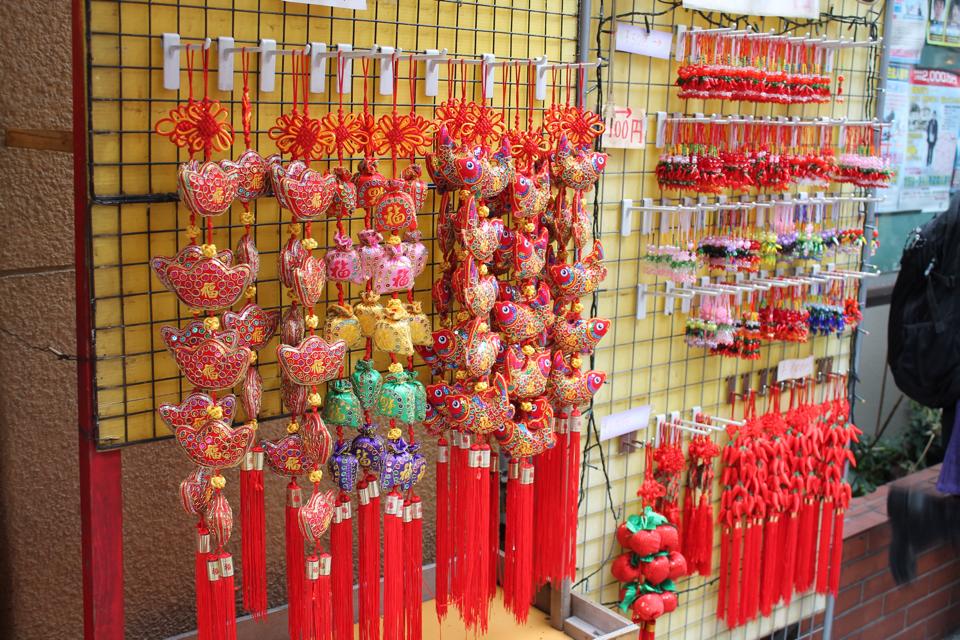
I turn away from the seaside to the town side, cross a huge gate, that looks like a temple gate, what is overdone, and suddenly ......I'm in China. Wow, how cool is that. Everything is multimulticolored and feisty, Japanese countenance switched to relexed composure. People do eat in the streets while walking, crossing the same after looking left and right and not to the traffic light. The shops offer knickknack and bric-a-brac and other important stuff and the people speak Chinese. I'm in Chinatown, the biggest one, not even in Japan, but in Asia, round about 3000 Chinese do live here and 250 Chinese themed shops are here, there are more of those pompous gates and the Kantai-Byo, a splendid, rich colored temple, dedicated to the god of commerce, and with such a gorgeous place to pray, business can't went wrong.
Ich wende mich dem Meer ab und der Stadt zu, durch ein großes Tor, das aussieht wie der Zugang zu einem Tempel, der es ein bisschen übertrieben hat und plötzlich.....bin ich in China. Ja, wie geil ist das denn. Alles ist quietschbunt und quirlig, die japanische Contenance wurde abgelöst von entspannter Gelassenheit. Hier isst man auf der Straße im Gehen, oder überquert dieselbe nachdem man nach links und rechts und nicht auf die Ampel gesehen hat. Die Geschäfte bieten Krimskrams, Schnickschnack und andere wichtige Sachen an, und die Leute sprechen chinesisch. Ich bin in Chinatown, der größten ihrer Art nicht nur hier in Japan, sondern in Asien. Hier leben rund 3000 Chinesen, es gibt ca 250 Läden, die ausschließlich chinesische Waren handeln.Es gibt noch mehrere solch prunkvoller Tore und den Kantai-Byo. Der farbenprächtige, opulent verzierte Tempel ist dem Gott des Handels gewidmet und bei soviel Herrlichkeit können die Geschäfte nicht schlecht gehen.
I do leave the port of the future and go into the old city center of Yokohama. At first Yamashita park. It's here since 1930, rose from ruins, built out of the rubble of the Great Kantō Quake after the idea of the Scotsman Marshall Martin, who was an adviser for major Ariyoshi Chuichi. The park is boardwalk and pier for water busses, the luxury liner Hikawa Maru, which went from Yokohama to Seattle and back in the 30s is moored here, because it's a museum nowadays, here we find the 'Guardien of Water', a sculpture which is a gift from San Diego, the sister city, there is much green, trees, flower beds, fountains, sculptures, crows, dogs, oh, and humans, humans are there too. The Marine Tower is standing there, 106 meters high, the highest inland-lighthouse of the world.
I turn away from the seaside to the town side, cross a huge gate, that looks like a temple gate, what is overdone, and suddenly ......I'm in China. Wow, how cool is that. Everything is multimulticolored and feisty, Japanese countenance switched to relexed composure. People do eat in the streets while walking, crossing the same after looking left and right and not to the traffic light. The shops offer knickknack and bric-a-brac and other important stuff and the people speak Chinese. I'm in Chinatown, the biggest one, not even in Japan, but in Asia, round about 3000 Chinese do live here and 250 Chinese themed shops are here, there are more of those pompous gates and the Kantai-Byo, a splendid, rich colored temple, dedicated to the god of commerce, and with such a gorgeous place to pray, business can't went wrong.
Abonnieren
Posts (Atom)