Samstag, 7. September 2013

Antonio Gaudí - Anbetung der Natur - Worship of Nature

"Wollen sie wissen, wo ich mein Vorbild gefunden habe? Ein aufrechter Baum: er trägt seine Äste und diese die Zweige und diese die Blätter. Und jedes einzelne Teil wächst harmonisch, großartig, seit der Künstler Gott es geschaffen hat. Dieser Baum braucht keine äußere Hilfe. Alle Dinge sind in sich ausbalanciert. Alle Dinge sind im Gleichgewicht." - A. Gaudí
1852 als 5. Kind einer eher armen Familie geboren, die Mutter kam aus einer Töpferfamilie, der Kupferschmied, zeigte er frühzeitig, dass er etwas Besonderes war, Talent hatte und kreativ war, er tat sich in Geometrie hervor und entwarf Bühnenbilder für schulische Theateraufführungen. Später als Student der Architektur zeigte er hier, wie so viele Genies, eher mäßige Leistungen, aber er studierte dafür außerhalb des Unterrichts politische, wirtschaftlich, gesellschaftliche Zusammenhänge und ihre Wirkung auf die Entstehung von Gebäude. Sehr schnell entwickelte er seinen eigenen Stil, geprägt von nationalistischer Sehnsucht, die er mit den meisten Katalanen teilte und einer romantisch verklärten Sicht auf das Mittelalter gepaart mit einem tiefen Respekt vor der Natur und der Fähigkeit die Vollkommenheit darin zu sehen. Und das macht seine Originalität aus.
Und so entstehen seine Bauwerke, steinerne Bäume, geschmiedete Blätter und Ranken, Türme und Säulen, die sich wie Schlangen winden, Häuser, gepanzert mit Schuppen wie der Drache und alles in allen Farben des Regenbogens.....


"You would like to know, where I found my model? A an upright tree: he wears his branches, and those the twigs, and those the leaves. And each part grows harmonic, magnificent, since God the artist made it. This tree does not need any help from outside. All the things are in balance itself. All the things are in equilibrium ." A.Gaudí
Born in 1852 as the fifth child to a more poor family, the mother came from a potter maker family, the father was a coppersmith, showed he very early that he was special, talented and creative. He was very good a geometries and build sceneries for the theatre show in school. Later as a student of architecture he was not that good, like most of the geniuses, but beside his lessons he studied hard, politics, economies and social issues and their influence on the creation of buildings. Very soon he found his own style, characterized by a desire for an own nation, like all catalan people, and a romantic glorified view at the medieval age, paired with a deep respect for nature and the ability to see the perfection in it. And that makes his originality.
And so his buildings are made of stony trees, iron leaves and tendrils, towers and pillars are winding like snakes, houses, clad in dander like the dragon and that in all colors of the rainbow....

Freitag, 6. September 2013

Auf zu Neuen Ufern - conquer new frontiers

Am Ende, oder am Anfang, je nachdem wie man die Sache betrachtet, also dort, wo die Ramblas auf den Hafen trifft, steht Christoph Kolumbus. Also, ein Standbild von ihm, hoch oben auf einer Säule, drinnen gibt es einen Aufzug und man kann ihn so besuchen und nebenbei die Stadt von oben sehen.
Hier ging Kolumbus 1493, nach seiner ersten Entdeckungsreise an Land und brachte sechs Ureinwohner mit, welche später in der Kathedrale getauft wurden, welch ein Triumph, für die Europäer....
Das Monument wurde zur Weltausstellung 1888 errichtet und da steht er nun und zeigt mit ausgestrecktem Arm wohin er gesegelt ist, jedenfalls so ungefähr, genaugenommen zeigt er mehr so Richtung mittlerer Osten. Aber er wollte ja auch nach Hinterindien segeln und landete auf den Antillen. Warum können Männer eigentlich nie nach dem Weg fragen.
Ich muss nicht fragen, denn der Weg zum Hafen ist offensichtlich. Ich schiffe mich ein auf einer Golandrina, einer Schwalbe, ein kleines zweistöckiges Boot, dass den Hafen befährt. Es ist eine Rundfahrt und Kursabweichungen sind ausgeschlossen. Zuerst geht es in Richtung Industriehafen, vorbei am Montjuïc und von der Seeseite hat man einen schönen Blick auf den großen Friedhof an den steilen Hängen des Berges und die Toten haben einen schönen Blick aufs Meer, oder so.
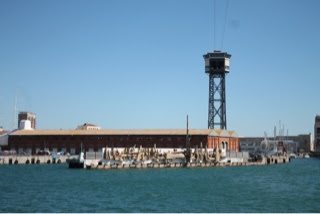
Der Industriehafen ist wie jeder seiner Sorte, große, größere und größte Containerschiffe liegen dort, werden be- und entladen, rein oder raus gelotst, und so weiter. Dann ein großer Bogen und wir sehen das Olympische Dorf und dahinter die historische Altstadt mit der Sagrada Familia, die selbst zwischen den modernen Hochhäusern noch groß aussieht. Weiter geht's zum Yachthafen, hier gibt es haufenweise Boote, viel Kultur und viel leckeres Essen in zahlreichen Restaurants und Cafés, alle mit Blick aufs Meer. Dann vorbei am alten Zollhaus, einem prächtigem Gebäude, das vor 110 Jahren erbaut wurde und zurück zum alten Hafen, an dem Stufen ins Wasser führen.


At the end or the begin, depend on the point of view, at the place where the Rambla meets the port is Christoph Columbus standing, his statue, high above on a pillar, inside is a lift and you can go up and meet him and have a nice view on the city as well.
At this place he went ashore in 1493 when he came back from his first journey and he brought six First Nations with him, they later were baptized in the cathedral, what a triumph, for the Europeans....
The monument was errected for the World Exibition 1888, and there he stands now with extended arm and shows us where he went, kind of, he shows more in the direction of Middle East, somehow. But in fact he wanted to sail to East Asia and arrived at the Antillian Island. Why can't men never ask wich way to take.
I don't have to ask for the way, it's obvisious where the port is. And so I go on board on a Golandrina, a swallow, a two floor boat the cruises in the harbour. It's a round trip and a yaw should be impossible. At first it goes into the industrial port, across the Montjuïc and there is a fine view from the seaside at the large cemetery at the steeply walls of that hill, and the dead can watch the sea all times, kind of.
The industrial port is like each of its kind, big, huge and giant container ships are anchoring there, to be load and unload, are driven in and out and so on. Then the boat makes a big circle and than we see the Olympic Village and the historic city center and the Sagrada Familia, which looks even among the new high buildings huge. On it goes to the marina, and here are loads of boats, lot of culture and a lot of tasty food served at restaurants and cafés with a view at the sea. Then we pass the Old Customer House, a beautiful impressive building from 1902 and back to the old port which steps lead into the water.